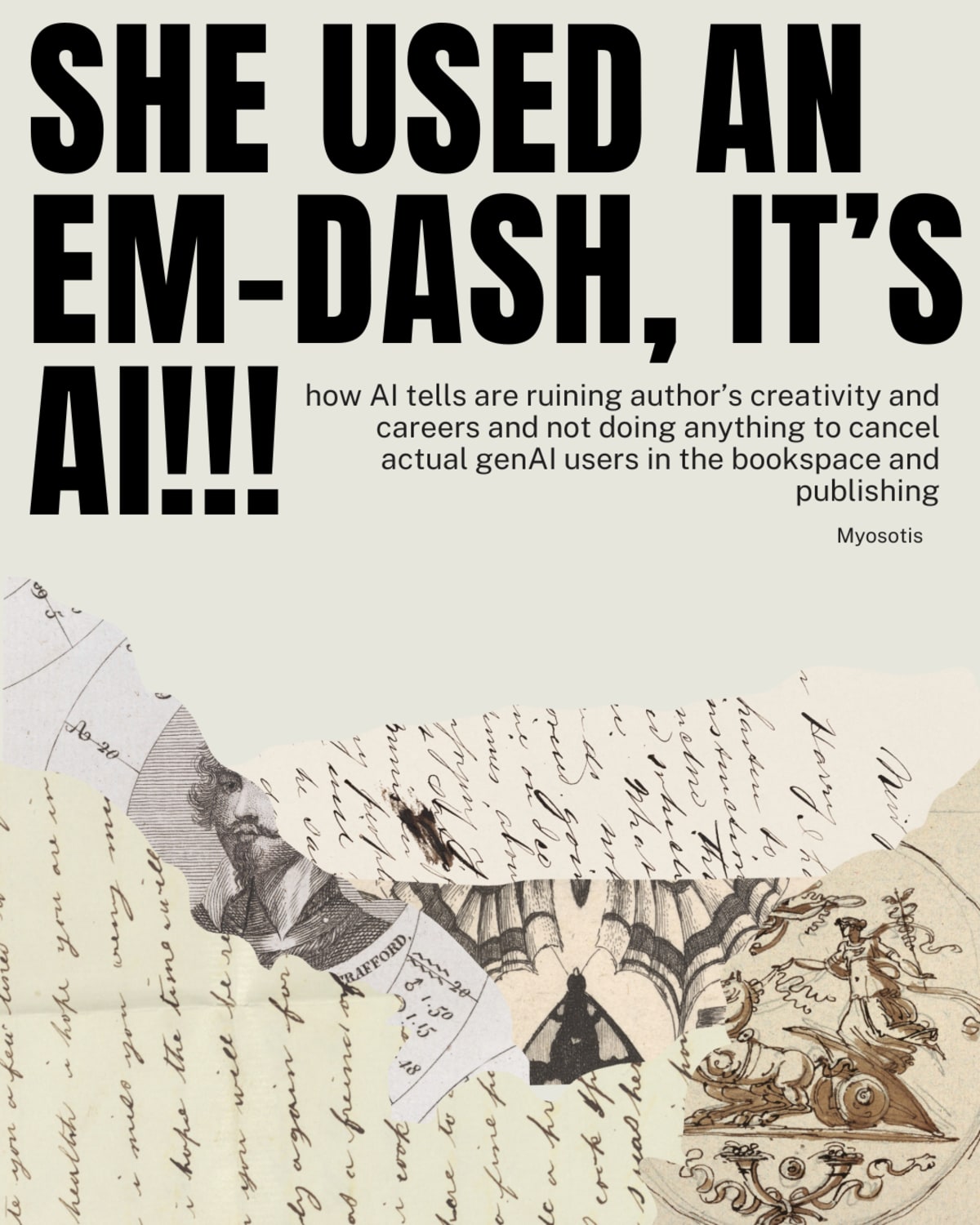
We've been in the book-space enough to read these few lines : 'em-dashes, the oxford comma, excessive use of similes and metaphors...' are AI tells in writing.
Then starts the witch hunt on social media, the mass-hate campaigns to boycott authors and ruin their entire careers and reputation over the opinion of one (often uninformed, uneducated) person who has no actual proof beyond 'it's giving ai'.
All of this is happening while actual AI generated books flood the KU market - with absolutely no check-ups, no boycotting - and saturate spaces where indie authors once thrived.
Didn't you just say you can't say it's ai without proof? When random authors start popping up on KU with obviously AI generated covers and pump out 2-3 KU novels a day, I think it's safe to say it's probably someone using AI. That's pretty much the only scenario I can think of where it's blatantly obvious.
Otherwise, I ask, who are bookstagrammers and readers to say who is using AI ? Who are they to make or break careers over 'a feeling' ? And how can authors grow and feel safe in a space that's becoming harder to navigate each day ?
Let me tell you, it's hell out here - or at least, for a while, it was.
When I sat down to write, I'd rethink every sentence and word : does this sound like AI? Why did I add an em-dash here? Oh no, cut it out, reword the sentence. Too many similes. Cut. Re-write. Start over.
What happened?
The more I wrote, the less I felt like writing. The more I censored myself, my own thoughts and writing patterns, the less I sounded like...me.
We all have a voice, a style, a way to compose sentences that's a dash unique but also learned from reading, school, writing. The more I wrote keeping in mind these so called 'ai tells', the less my writing made sense. It didn't feel like me, it had no feeling, no emotion, no colour, nothing - it sounded like a machine. Like someone from 2006 might describe a machine's writing with no context of what kinds of things a machine can do just 20 years later. It was driving me crazy: not only was I overthinking every single word I typed, but I was also losing my passion for writing.
Suddenly, it wasn't something enjoyable, it felt like work. Like a constant battle between me, my brain, my patterns and 'ai tells' that I had to absolutely obliterate from my writing to protect myself from (unwarranted) potential accusations.
It was censorship. It wasn't me. It wasn't my voice. Fear of being unjustly accused in the future led me to hit a creative wall.
Then I realised I probably wasn't alone in this. I talked to other authors and realised we were all fighting the same mental battle. That we were all trying to find ways to protect ourselves and losing our voice in doing so.
Isn't that just crazy?
How we're all out there literally picking our brains apart and destroying our own creativity because of fear? That we're ourselves sounding like machines to avoid sounding like a machine, while the machine keeps being fed on human work and creativity and sounds more and more like a human?
It's mental.
And I've had enough.
So I deleted everything. I deleted the very notion of 'ai tells' from my brain. I deleted fear of being cancelled, of being wrongfully accused, of my career going up in flames because of some random person's accusation on the internet. I consciously decided not to give a single (pardon my language) fuck, and I feel relieved.
Writing feels good again.
And is that not something you, as a reader, wish on your favourite authors? On any author? To feel safe, good, and happy in their craft?
If the answer is yes, then let me give you some advice - take it or leave it, you do you.
Here's the thing: unless there's a prompt or embed coding in there somewhere, you can't definately know if an author has used AI in their writing.
It's speculation. Speculation isn't proof.
Without proof, you can't go around throwing accusations that get blown out of proportion.
That's irresponsible and selfish.
I see so many readers throwing these accusations around the moment they didn't enjoy a book, the writing, the characters - instead of just admitting not every book and style is for everyone to enjoy and moving on. You're allowed to find a book shit. To find it boring or not to your taste, to not really vibe with the style. What you're not allowed to do is accuse someone of using AI without undisputable proof. You want to think it? Sure, absolutely - you can keep that opinion to yourself or a few chosen others, a book club or what not. But don't go on the internet and blow an OPINION (not proof, not fact) out of proportion just for views while destroying someone else's livelyhood.
Now for my fellow authors, what can we do to protect ourselves from these accusations?
While we can't be 100% safe from accusations, I think there's a few things we can do to make sure anyone who comes across our work, books, social media etc can be certain of our values.
If you do NOT use generative AI :
1. Clearly state you're against genAI on your socials. Bio, posts, reels, blog... you choose.
2. In every published book, in the copyright section, add a mention of the sort : 'generative ai was not used in any part of the drafting, writing and editing of this book and the author does not authorise using this book to train generative ai' - or something of the sort.
If you use SOME generative AI : specify in which part - was it in the drafting, research, editing? I'm judging you.... but still, transparency is best, your readers will be advised of the product they're consuming and the moral implications of consuming your media as well as the compromises you're willing to make in your own creative spaces.
If you use generative AI for everything : you're not an author! you're a prompter and a thief. You should specify that the product you are selling was written by AI. This way readers are 100% aware what they're reading is trash and they won't confuse you with a real writer.
I suppose my final point is this : if you're a reader, don't throw accusations without proof just for click-bait and views. If you're an author, be transparent about your views on genAI, and don't let someone else's voice censor your own ever again.
Cheers,
M.
PSA for anyone that's new here : in case you don't already know, I'm against genAI in creative or any other spaces. If you need Chatgpt to write your emails or to be your therapist, I fear you're too far gone and probably don't need to read the rest of this post: by now, 2026, the disastrous environmental, sociological, neurological consequences of the mass-use of genAI are well documented are known - too much for you to pretend otherwise, so I'm going to assume you're using genAI knowing how harmful it is to yourself and others.
I do not use genAI in any part of my writing, drafing, editing or overall in anything in my life and that includes my writing. If you're into 100% trauma and human made books that will have the occasional typo, then check out any one of my works.